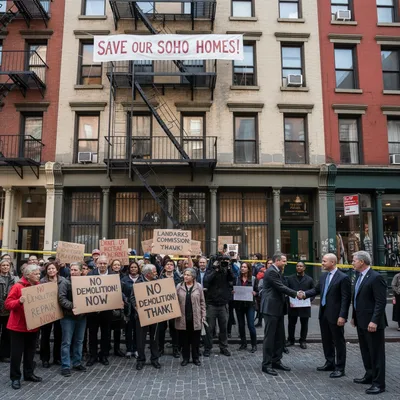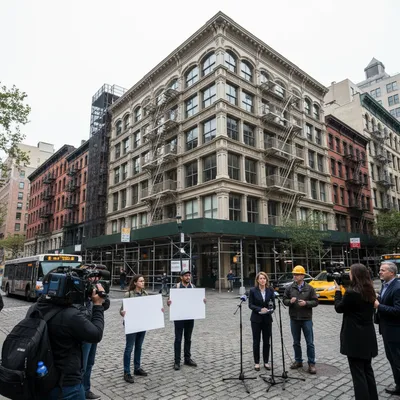
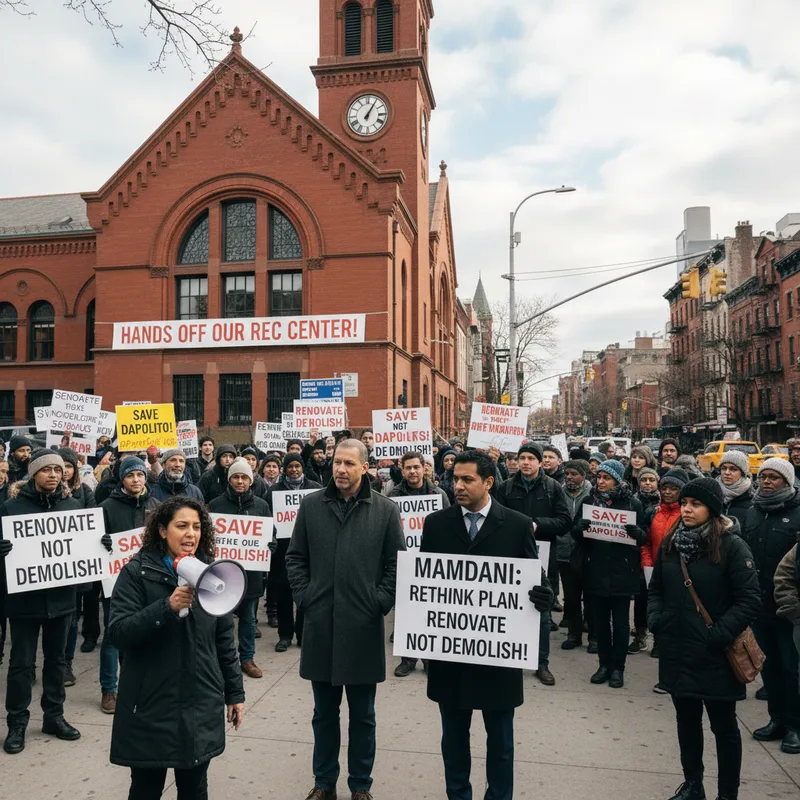
Assembly Member Grace Lee and a coalition of downtown community groups gathered in Greenwich Village on Sunday, urging Mayor Zohran Mamdani to save the Tony Dapolito Recreation Center. Protesters chanted for the city to “renovate, not demolish” the beloved local landmark and swimming pool at 1 Clarkson St., which has been shuttered for years due to structural concerns.
The rally, which drew about 100 residents, was spearheaded by the grassroots nonprofit Village Preservation. The group released government records obtained through a year-long Freedom of Information Law (FOIL) request, which they argue contradict the city's assertions that the historic center is beyond saving. Joining the call were several other community organizations, including the Downtown Independent Democrats, the SoHo Alliance, and the Village Reform Democratic Club, all united against the proposed demolition.
The controversy stems from a $164 million revitalization plan for the Clarkson Street corridor, introduced by former Mayor Eric Adams. The plan calls for the complete demolition of the Dapolito Center, which was designated a city landmark in 2010. In its place, the city intends to build a modern outdoor pool complex. A separate indoor recreation facility would be constructed across the street at 388 Hudson St. as part of a new affordable housing development, a project model seen in other major retail and residential projects like the new Babylist flagship store that recently opened in SoHo.
City argues renovation is impractical
The NYC Department of Parks & Recreation has defended its proposal, stating that demolition and new construction are the most viable options. Officials said the city has allocated approximately $100 million to reconstruct the center and that multiple investigations revealed serious structural problems. According to the Parks Department, renovating the existing structure to meet modern building codes would lead to "significantly less usable space."
Specifically, a renovation would shrink the pool from three lanes to two, result in a non-regulation-sized basketball court without any spectator seating, and leave the indoor track inaccessible under the Americans with Disabilities Act (ADA). Officials also expressed concern that further structural issues would likely be discovered during a restoration, driving up costs beyond the building's value while compromising essential programming space.
Despite these claims, community advocates remain unconvinced, pointing to the documents they recently obtained as proof that a different path is possible. The dynamic of local demonstrations challenging government proposals is a familiar one in civic life, with similar scenes playing out in communities across the country, like the rallies in Maine against federal policies.
Leaked documents suggest repairs are
imminently doable'
Andrew Berman, the executive director of Village Preservation, told the crowd that the city’s own experts concluded that the building is salvageable. "It revealed is that it’s all repairable," Berman said of the FOIL documents. "What they’ve been contending is that the repairs can’t be done. And what this found is that their own experts and engineers said it’s imminently doable, and here’s the plan for doing it."
It’s the most common thing in the world to say you have an old building that needs some repairs. It’s like saying sometime this year it’s probably going to rain.
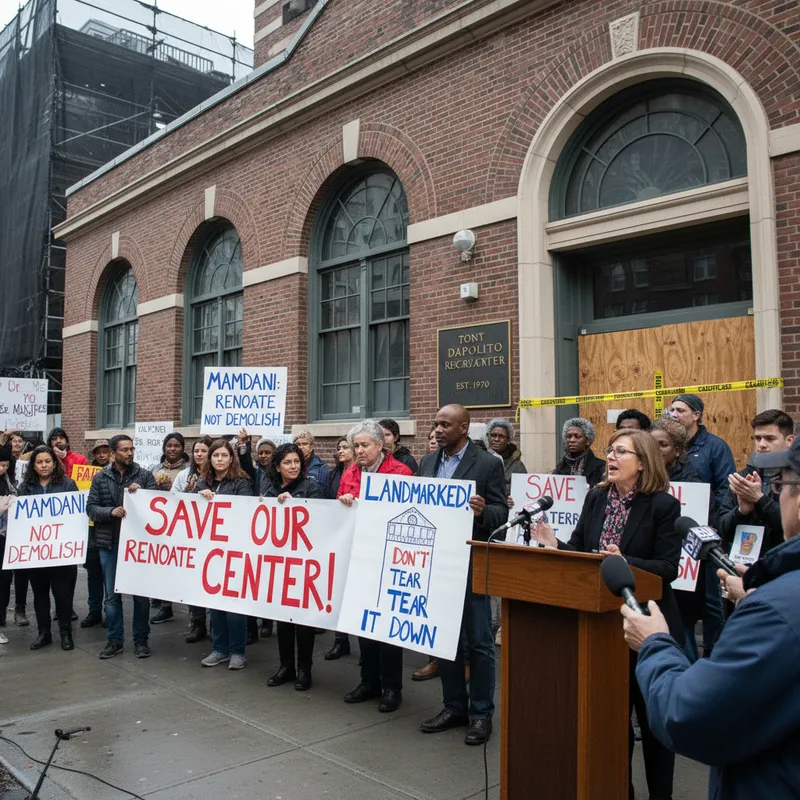
Berman issued a direct call to the new administration, noting that Mayor Mamdani had supported renovating the site during his campaign. He emphasized that time is of the essence. "The longer he waits, the harder it’s going to be to repair the building," Berman said. "So we’re going to hold him to his word, and we want him to move soon."
A community
s soul and spirit
The recreation center has been closed to the public since the COVID-19 pandemic, with its adjacent outdoor pool having closed even earlier in 2019 for similar structural reasons. An initial plan to renovate the facility stalled before the city pivoted to the current demolition proposal, which it stated was shaped by local feedback, a claim protesters now contest.
Assembly Member Lee, representing New York’s 65th District, firmly sided with the residents. "It’s unfathomable to me that city officials have repeatedly claimed that the facility could not be saved, while failing to produce any supporting documents to provide to back that up," Lee said at the rally. She declared the center "worth preserving," calling the effort to save it a reflection of the "soul and spirit of the community."
Lee also raised a significant legislative hurdle for the city’s plan, noting that the Dapolito Center is on designated parkland. Any move to demolish the structure for a new building would require rezoning, a decision that needs approval from the state legislature. "I’m here to say that we will continue to protect this property as protected parkland," Lee pledged. "We are calling on Mayor Mamdani to honor his commitment to repair, not demolish."
More than just a building
Speaker after speaker emphasized the center’s role as a vital community anchor for generations. Mar Fitzgerald, a Democratic district leader, described it as a "second home for every village kid" where children learned to swim, took classes, and built lasting friendships. "It was a foundation and a place where generations of young people found support structure and belonging," Fitzgerald said.
The center’s importance extends beyond youth programs. Local resident Elizabeth England, who used the pool for physical therapy in the 1990s, highlighted the lack of affordable swimming options for adults in the area. "There’s an Equinox right over there… but we have nowhere for the middle and working-class to swim," she said. England lamented the ongoing gentrification of the neighborhood, a trend that has transformed much of the area into a high-end retail destination as detailed in guides to SoHo shopping. The Dapolito Center, she argued, stands as a "bastion" of a more inclusive era.
Hank Dombrowski, a swimmer who attended the rally in a swimming cap and goggles, echoed the sentiment. He recalled competing in adult lap swimming events that fostered a unique sense of community. "You don’t see people like all winter long. You come back and you just feel the community," he said. "It’s like a pub."
A working-class history
Berman noted that the fight to preserve the building is also about honoring its history. The facility first opened on May 6, 1908, as a public bathhouse for the neighborhood’s poor and working-class immigrants who lacked indoor plumbing. It later evolved into a recreation center that welcomed people from all socioeconomic and racial backgrounds.
“It continued to be a place where people from every socioeconomic background, racial background, every part of the city came and mixed because it was it was free or low cost,” Berman said. This historical significance was a key factor in the successful campaign to have it designated a city landmark. The building also contains an 18-foot-long mural by the iconic artist Keith Haring, which was dedicated in 1987. Both the city and preservationists agree that the valuable artwork must be preserved, regardless of the building's fate.
As the standoff continues, advocates insist that their vision for the center is not an obstacle to progress. Berman said the community would welcome a new recreation facility in the building across the street but that it should not come at the cost of the existing landmark. "Everybody agrees that some new recreational facilities in the new building is great, but everybody says they want this building repaired, restored, renovated," Berman said. "Mayor Mamdani said he’s looking at everything with fresh eyes. He’s got to look at this with fresh eyes as well."