Overview
The Manhattan Bridge is a majestic suspension bridge spanning the East River, serving as a vital artery connecting Lower Manhattan's vibrant Chinatown, near SoHo, with the trendy DUMBO neighborhood in Brooklyn.
Opened in 1909, it is an engineering marvel and a cornerstone of New York City's infrastructure.
Less crowded than its famous neighbor, the Brooklyn Bridge, it offers a uniquely gritty and authentic NYC experience for walkers, cyclists, and photographers.
Designed by Leon Moisseiff, the bridge is notable for its innovative use of deflection theory and the grand, Beaux-Arts-style arch and colonnade that mark its Manhattan entrance.
It's a multi-modal crossing, carrying seven lanes of traffic on two levels, four subway lines, and dedicated paths for pedestrians and cyclists.
For visitors and locals alike, it provides a functional crossing and a recreational destination with unparalleled views of the city's iconic skyline.
What to See & Do
The primary activity on the Manhattan Bridge is the walk itself, offering a journey through the city's visual landscape. The experience is a feast for the senses, from the rumble of the subway trains to the panoramic vistas.
- Walk the Pedestrian Path: The dedicated walkway on the bridge's south side provides a safe and direct route across the East River. It’s a fantastic way to see the city from a different perspective, with dynamic views of the Brooklyn Bridge, the Statue of Liberty, and the Lower Manhattan and Midtown skylines.
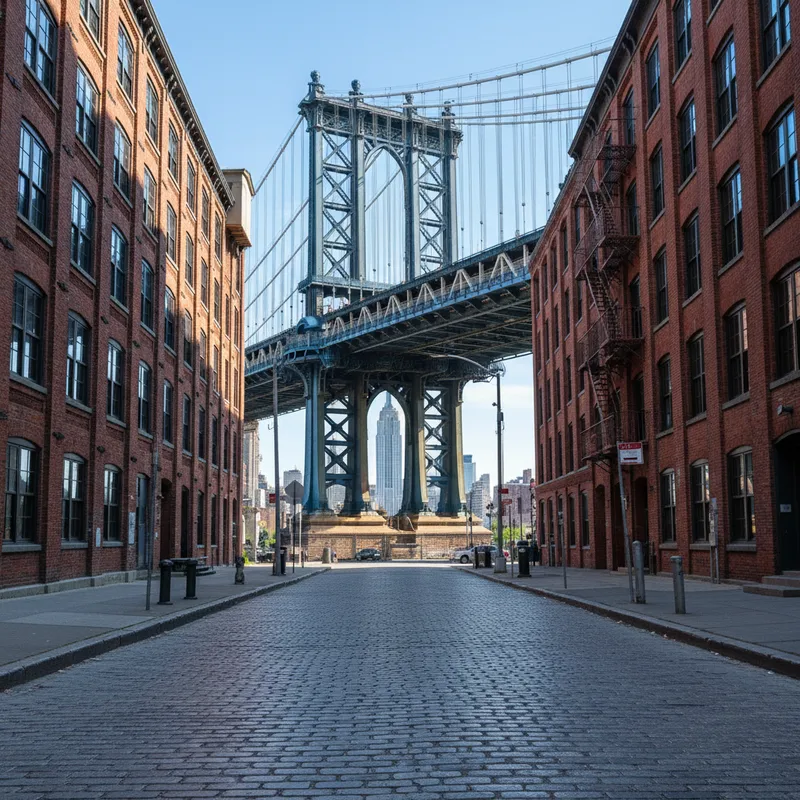
- Prime Photography Spots: The Manhattan Bridge is a photographer's dream. The middle of the span offers unobstructed, postcard-perfect views of the Brooklyn Bridge with the Financial District's skyscrapers as a backdrop. On the Brooklyn side, head to the intersection of Washington Street and Water Street in DUMBO for the world-famous shot of the Empire State Building framed perfectly within the bridge's steel supports.
- Watch the Subway: One of the unique features of the Manhattan Bridge walk is the proximity to the subway tracks. Feel the rumble and watch the B, D, N, and Q trains emerge from the city tunnels and speed by, adding a kinetic, urban energy to the experience.
- Explore the Terminus Neighborhoods: The walk serves as a perfect connection between two must-visit areas. Start in the bustling streets of Chinatown near SoHo, known for its incredible food and lively markets, and end in DUMBO, with its cobblestone streets, art galleries, and waterfront parks.
Facilities & Amenities
As a public thoroughfare, the Manhattan Bridge itself does not have dedicated facilities. There are no public restrooms, cafes, or visitor centers located on the bridge span. However, both the Manhattan and Brooklyn ends of the bridge are located in dense urban neighborhoods with abundant amenities.
In Manhattan, numerous cafes, restaurants, and shops are available in Chinatown and the nearby SoHo and Nolita districts. In Brooklyn, the DUMBO neighborhood offers public restrooms in Brooklyn Bridge Park, as well as numerous trendy cafes, pizza spots, and boutiques just a short walk from the bridge's exit.
Getting There
Accessing the Manhattan Bridge pedestrian path from the SoHo side is straightforward.
- Address: The Manhattan entrance to the pedestrian walkway is located at the intersection of Bowery and Canal Street in Chinatown, a short walk from SoHo. Look for the grand stone archway.
- Public Transport: The bridge is well-served by the NYC Subway. The Canal Street station (serving the N, Q, R, W, J, Z, 6 trains) and the Grand Street station (B, D trains) are both a few blocks from the entrance.
- Parking: Street parking is extremely limited and difficult to find in this area. Several private parking garages are available, but they can be expensive. Public transportation is the highly recommended option.
- Cycling: A separate, dedicated bikeway is located on the north side of the bridge, providing a safe route for cyclists. The entrance is near the same intersection.
Best Time to Visit
The Manhattan Bridge is open 24/7 and is a compelling destination at any time of day, year-round. For the most comfortable and visually rewarding experience, consider visiting on a weekday to avoid the larger weekend crowds.
Early mornings offer soft light and relative solitude, perfect for photographers. The hour leading up to sunset, known as the "golden hour," provides a breathtaking spectacle as the sun dips below the horizon and the city lights begin to twinkle on.
Be prepared for windy conditions, especially during the colder months, and wear appropriate clothing.
History & Significance
Opened on December 31, 1909, the Manhattan Bridge was the third of the great suspension bridges built across the lower East River.
Its design by Leon Moisseiff was groundbreaking, as it was the first major suspension bridge to employ "deflection theory," which posited that bridges were inherently stronger and more flexible than previously believed.
This allowed for a lighter, more slender design without the massive stiffening trusses seen on the nearby Williamsburg Bridge.
The bridge’s Manhattan entrance is marked by a magnificent arch and colonnade designed by the renowned architectural firm Carrère and Hastings, who also designed the New York Public Library.
In recognition of its engineering importance, the American Society of Civil Engineers designated the Manhattan Bridge as a National Historic Civil Engineering Landmark in 2009, its centennial year.
Walks & Trails
The main "trail" is the pedestrian path across the bridge itself, an easy and rewarding urban hike.
- Name: Manhattan Bridge Pedestrian Walkway
- Length: The walkway is approximately 1.3 miles (2.1 km) from entrance to exit.
- Difficulty: Easy. The path is almost entirely flat, with a very gentle incline to the center of the span. It is suitable for all fitness levels.
- Duration: A one-way walk typically takes between 25 and 40 minutes at a leisurely pace, though you'll want to allow extra time for photo stops. A round trip, including exploring the DUMBO waterfront, can easily take 1-2 hours.
- Highlights: Continuous, stunning views of the East River, Governor's Island, the Brooklyn Bridge, and both the Lower Manhattan and Midtown skylines.
Visitor Tips
To make the most of your visit, keep these insider tips in mind:
- Wear Comfortable Shoes: While the walk is not strenuous, you'll be covering over a mile on a hard surface.
- Be Mindful of Noise: The subway trains run adjacent to the walkway and are very loud. If you are sensitive to noise, you may want to bring earplugs.
- Stay on the Path: The bridge has separate, clearly marked lanes for pedestrians and cyclists. Be aware of your surroundings and stay in the pedestrian lane to avoid collisions.
- Bring Water and Snacks: There are no concessions on the bridge, so it's wise to carry your own water, especially on a warm day.
- Check the Weather: The bridge is exposed to the elements. It can be significantly windier and colder over the river than on the city streets. Dress in layers.