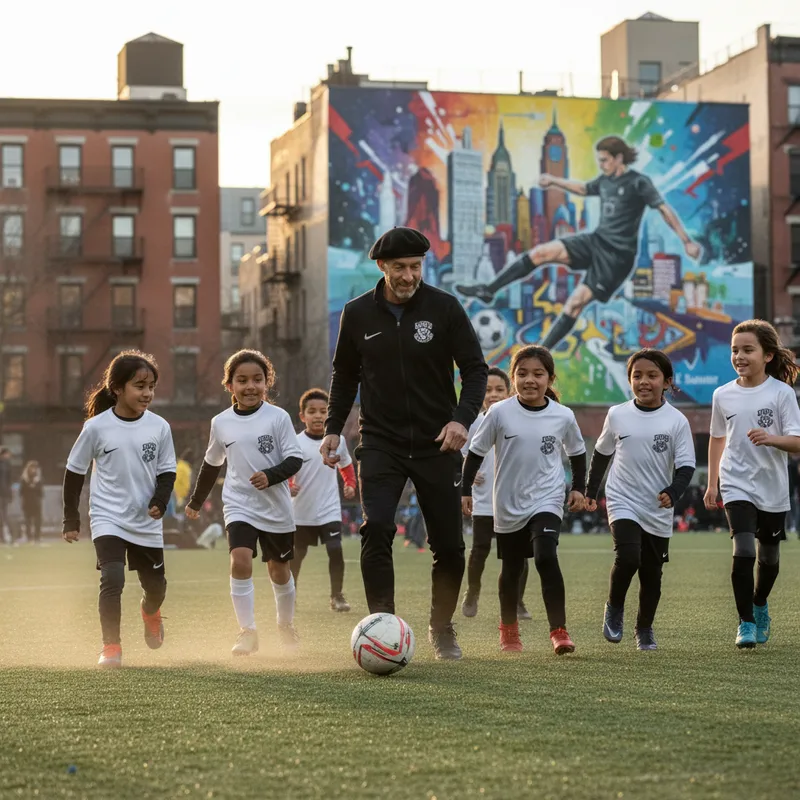
When Erwan Saunier arrived in New York City from France in December 1999, he came with a work visa and a burgeoning career in luxury retail. More than two decades later, he is not known for selling sporting goods in SoHo, but for his profound impact on hundreds of young soccer players and for his vibrant, textured oil paintings that have captivated collectors.
Saunier’s journey is one of remarkable resilience, marked by a series of dramatic highs and lows, from a career-ending injury and homelessness to finding his true calling on a soccer pitch in an East Village park and in front of an artist’s canvas.
His story begins not in a bustling city, but in a rustic, off-the-grid home in Brittany, France. Raised by artist parents without electricity or running water, Saunier’s childhood was unconventional. “All the food was grown at home or traded. we fish, we poach, we hunt, we trap,” he recalls. This upbringing instilled in him a deep connection to the natural world, a theme that would later dominate his art.
While his father expected him to pursue art, Saunier was drawn to soccer. Born with a cleft palate, he was initially barred from local leagues but honed his skills in schoolyards until a neighbor recognized his talent and advocated for his inclusion on a team. His passion and skill propelled him into the world of semi-professional soccer in France.
A career cut short
At 23, Saunier’s athletic ambitions were shattered. A routine knee surgery went horribly wrong due to an anesthesia mishap. “I tried to move, and my right side wasn’t moving,” he says. The incident left him in a wheelchair for eight months, facing a grueling 15-month recovery where he had to relearn basic motor skills like walking, speaking, and even holding a pencil. His soccer career was over.
Undeterred, Saunier pivoted. He took a stock boy job in the basement of a Décathlon, a massive French sports retailer. His big break came when he was sent to the sales floor and single-handedly managed a massive order for Morocco’s soccer federation. This success led to an opportunity in New York, where he was tasked with opening a store on West Broadway in SoHo.
“Everything was booming. People were happy. Business was good,” he remembers of the city in the early 2000s. But his American dream soon turned into a nightmare. In 2003, a bitter dispute with his business partner left him jobless and, because his visa was tied to his work, without legal immigration status. “I ended up in the street,” he says. With a two-year-old son, Julien, he chose to stay in the U.S. illegally, finding work as a contractor on Fire Island.
After eventually securing a green card, Saunier sought solace in the one thing that had always brought him joy: soccer. He started training by himself in a park, and soon, a small group of children began joining him. “Kids started to come around, kick the ball with me,” he says. The sessions grew organically, without any promotion or fees, inspiring him to offer free classes.
More than a coach
His grassroots coaching efforts quickly gained notice, leading to a position as a soccer program director and, ultimately, a coaching role with the Manhattan Kickers, an East Side youth league where he is now the program director. The club has grown to include 10 travel teams and a recreational program serving about 600 children annually.
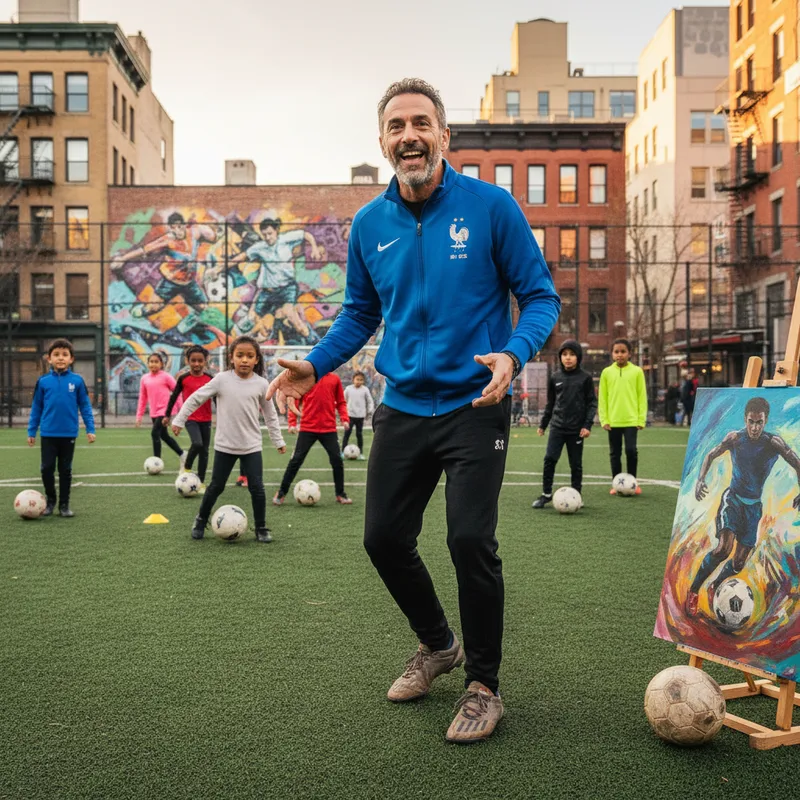
In a city where youth sports can be prohibitively expensive, Saunier is a vocal critic of the commercialization of the game. He keeps fees for his travel teams at around $1,800 a year, significantly lower than the $2,800 or more charged by competing clubs. His philosophy reflects his own humble beginnings with the sport. “Soccer is a poor people’s sport,” he says. “You need a ball and a friend.” This approach aligns with a broader movement in the city, championed by figures like "Coach Jake" at Martin Luther King High School and organizations like the U.S. Soccer Foundation, and initiatives such as the Brampton forum blending cricket and life skills, which work to make the sport accessible to all children, regardless of their economic background.
The impact of his mentorship extends far beyond the field, shaping his players into responsible young adults.
He is much more than simply a soccer coach. He taught kids not just how to be great soccer players, but great people.
Katherine Hochman, whose three children all played for the Manhattan Kickers under Saunier, attests to his profound influence. She says he fostered a sense of community and character that has stayed with her children long after they left the team.
A return to art
Despite his family background, Saunier himself did not begin painting until 2011. The catalyst was a surprising change of heart from his father, who had always dismissed oil painting. Near the end of his life, his father tried oils, discovered a latent talent, and urged his son to one day do the same. Shortly after his father’s passing in 2009, that day came.
Saunier remembers waking up one morning and telling his wife, Sandra, “I’m going to paint today.” When Sandra returned home from work, she found no walls repainted and asked if he had changed his mind. “He replied, ‘Yeah, go into the bedroom,’” she recalls. There, she found his first completed canvas. “I was completely shocked! You think you know somebody and he has never stopped surprising me,” she says. “Whenever he sets his mind to something, he does it.”
He began painting prolifically, exploring landscapes, flower fields, and animals. A turning point came when a Japanese collector saw one of his horse paintings and commissioned a series of large-scale works for a guitar museum in Japan. The project brought him unexpected visibility, but also pressure. “It started oppressing me. It became a job,” he says of the ensuing demands for agents and shows. “And that’s not what I want. I want it to stay fun.”
Art for fun
After a brief hiatus, Saunier returned to his craft with a renewed sense of purpose and a new artistic style. He developed a technique of painting bold, textured backgrounds and then 'pulling' animal figures from the layers of color. He recently showcased this new series, titled “Nature,” at a one-day exhibition at La Nacional, the historic Spanish cultural center in Chelsea. His vibrant work is also currently on display at Bread Story, a bakery in Stuyvesant Town.
Saunier attributes the intense color in his work to a rare visual condition called tetrachromacy. “I see 20 percent more colors,” he explains, allowing him to perceive subtleties and complexities in hue that most people cannot. His creativity also extends to steampunk-inspired sculptures and functional art, like lamps and clocks made from antique parts. In one ongoing series, he gives animal skulls a 'second life' by decorating them with vintage jewelry and wiring them into unique light fixtures.
Today, Saunier lives a quiet life with his wife in Stuyvesant Town, balancing his time between coaching and creating. He remains driven not by commercial success, but by the joy of creation and the opportunity to be a positive force in the lives of his players.
“I’m super careful to try to make these kids good little humans in the world we’re in,” Saunier says.